


Kilimanjaro Machame Route Overview — The Best Complete Guide to Climbing Mount Kilimanjaro
The complete Machame Route guide — the scenic Whiskey Route through rainforest, Shira Plateau, Lava Tower, the Barranco Wall and camping camps at Machame, Shira, Barranco, Karanga and Barafu. Compare 6-day vs 7-day itineraries, difficulty for beginners, success factors, altitude and acclimatization, cost, best time to climb, maps, expert tips and booking advice for Uhuru Peak (5,895 m).
What is the Machame Route?
The Machame Route — nicknamed the Whiskey Route for its tougher character next to the “Coca-Cola” Marangu Route — is the most popular way up Mount Kilimanjaro. Starting at Machame Gate on the south-west side of the mountain, it climbs through lush rainforest to Machame Camp, crosses the Shira Plateau, rises to Lava Tower for acclimatization, drops to the dramatic Barranco Camp, scrambles up the famous Barranco Wall, and continues via Karanga and Barafu camps to Uhuru Peak before descending the Mweka trail.
The route offers extraordinary variety in a short distance. You begin in dense montane rainforest, climb through heath and moorland, cross alpine desert beneath the glaciers of Kibo, and finally ascend to the arctic summit zone. The Barranco Wall, the Lava Tower ‘climb high, sleep low’ day, and sunrise at Stella Point are moments climbers remember for life.
Machame is our most-booked route at Kizza Adventures — and our firm advice is to take 7 days, not 6. The extra night at Karanga Camp transforms acclimatization and, with it, your summit chances. Fit first-timers do very well on the 7-day Machame; the 6-day schedule suits trekkers who arrive pre-acclimatized.
Why Choose the Machame Route?
Most Scenic Short Route
Machame packs rainforest, the Shira Plateau, Lava Tower, the Barranco Wall and the southern glaciers into 6–7 days. No other route of this length offers so much variety — it is the classic Kilimanjaro postcard trek.
Great Acclimatization Design
The route climbs high to Lava Tower (4,630 m) then sleeps low at Barranco (3,960 m) — the textbook ‘climb high, sleep low’ profile. Add the 7th day at Karanga and the profile becomes one of the best on the mountain.
True Traverse, No Repetition
You enter at Machame Gate and exit at Mweka Gate — every day brings new trail. Unlike out-and-back routes, you never retrace your steps until the final descent.
Camping Adventure
Machame is a full camping route: quality mountain tents, a mess tent for meals, and camps beneath the stars at Machame, Shira, Barranco, Karanga and Barafu. For many climbers, the camps are half the experience.
Busier Than Remote Routes
Popularity has a price: Machame is the busiest route on Kilimanjaro, and from Barranco onward you share camps with Lemosho and Umbwe traffic. Early starts and our guides’ timing keep you ahead of the worst of it.
6 Days Is Demanding
The 6-day schedule skips Karanga Camp and asks a lot of sea-level beginners. If you cannot arrive pre-acclimatized — fresh off Meru, Kenya or the Rwenzori — take 7 days. The extra day costs less than a failed summit.
Complete Machame Route Overview
Our Guides' Verdict on the Machame Route
Straight talk from the team that climbs it every month — which length to book, and who should skip the short one.
1,600+ climbers guided on Kilimanjaro
Machame is the route our guides climb most — and their advice never changes: take 7 days, not 6. The extra night at Karanga is the single biggest favour you can do your summit chances. Six days suits pre-acclimatized legs; seven days suits everyone else, including fit first-timers.
- Book 7 days for your best odds. The Karanga night completes the “climb high, sleep low” rhythm — Lava Tower by day, Barranco to sleep, Karanga to consolidate — that makes summits.
- 7 days is the honest standard. Fit first-timers with hill fitness do very well on seven; the Karanga night keeps the key acclimatization buffer while the cost stays fair.
- 6 days only if pre-acclimatized. The short schedule skips Karanga and suits trekkers fresh off high mountains (Meru, Kenya, Rwenzori) — not sea-level beginners.
- Expect company from Barranco. Machame is popular and Lemosho traffic joins from Barranco onward — our early starts keep you ahead of the crowds on the Wall and the summit push.
- Rainy season? Still climbable. The southern forests handle rain well and crowds thin out — with good gear, March–May and November climb beautifully.
- Climb it in the dry months if you can. June–October and January–March give the kindest skies for Barranco Wall photos and summit sunrise.
Climb with a Moshi-based team that briefs you the night before, walks every step with you, checks your health twice daily on the mountain, and meets you at Mweka Gate with your summit certificate. Message us on WhatsApp with your dates and trekking background — we will tell you honestly whether Machame 6 or 7 days is your route.
Machame Route — Day-by-Day Itinerary
The full 7-day and 6-day itineraries with hiking times, distances, elevations and camp photos — pick your trek length below. Our guides recommend 7 days.
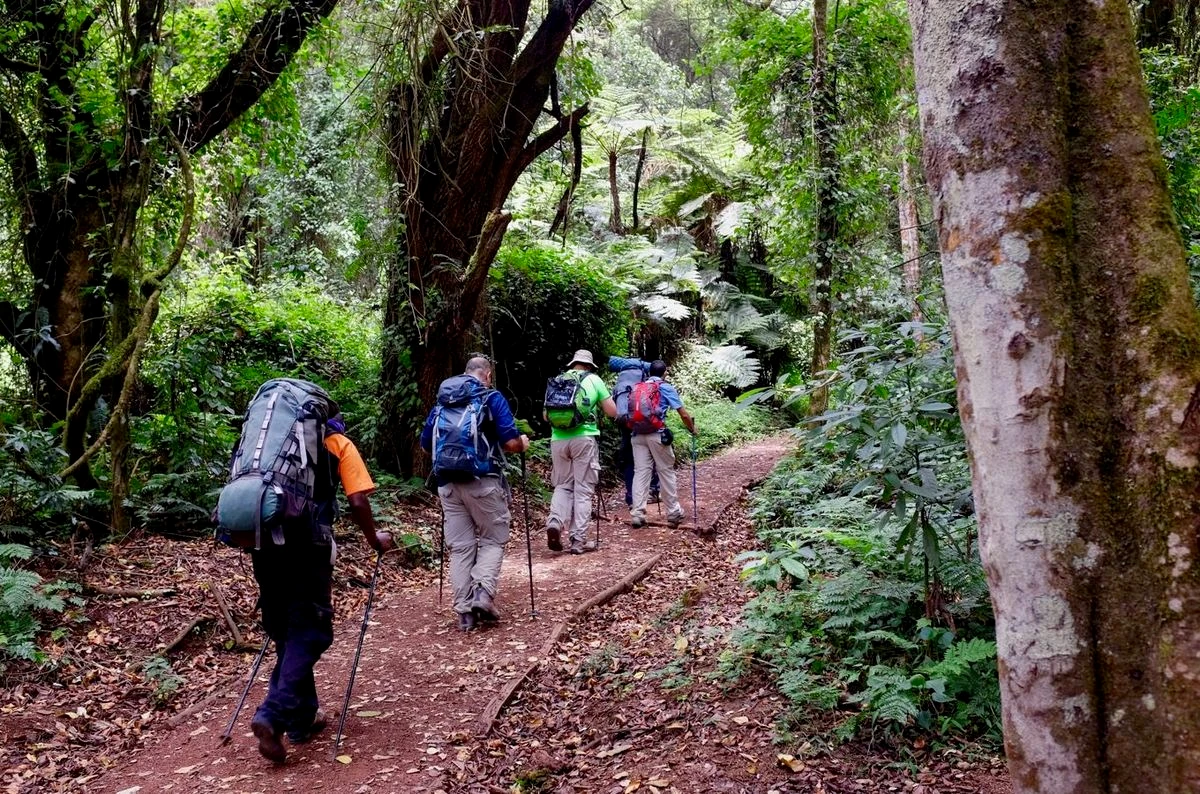
After breakfast in Moshi you meet your guide for a full trip briefing, then drive to Machame Gate (1,800 m) on the southern side of Kilimanjaro. While the crew weighs loads and your guide completes park registration, you eat an early lunch and watch the mountain reveal itself above the forest canopy. Registration queues vary by season and arrival time, so patience at the gate is part of day one.
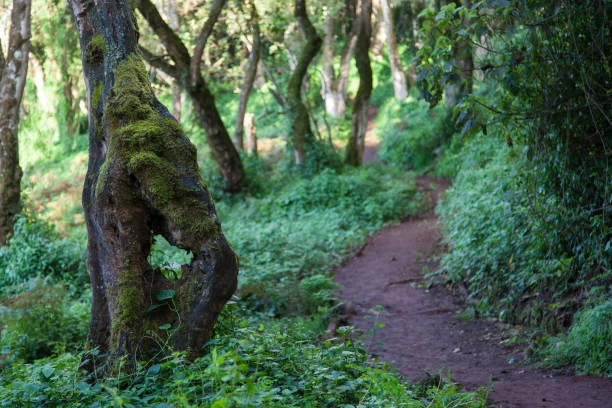
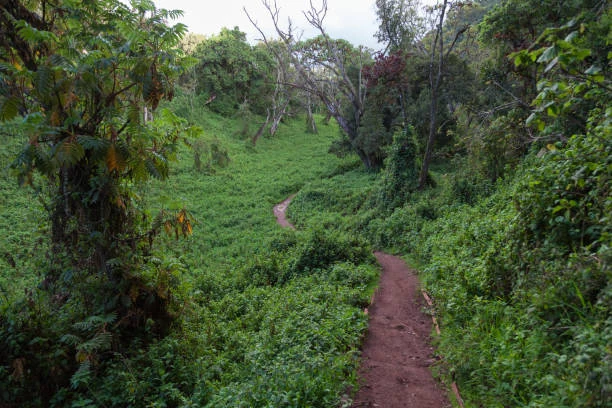
The trail climbs steadily through dense montane rainforest — moss-draped trees, giant ferns, bird calls overhead, and with luck black-and-white colobus monkeys in the canopy. Your guide sets a slow pole-pole pace from the very first step; walking slowly on day one is deliberate acclimatization, not caution. Porters pass with camp loads while you carry only a daypack with water, rain gear and warm layers.
After approximately 5–6 hours of trekking you reach Machame Camp (approximately 3,000 m), where your mountain crew will have prepared your campsite and hot washing water waits. Dinner is served in the mess tent, the guide briefs tomorrow’s longer climb, and you sleep early — headaches or poor sleep on night one are common and worth reporting honestly.
- Accommodation: Machame Camp (3,000 m)
- Meals: Lunch and dinner
- Trekking time: 5–6 hours
- Trekking distance: 5 km (3.1 miles)
- Altitude: Approximately 3,000 m above sea level; elevation gain approximately 1,200 m
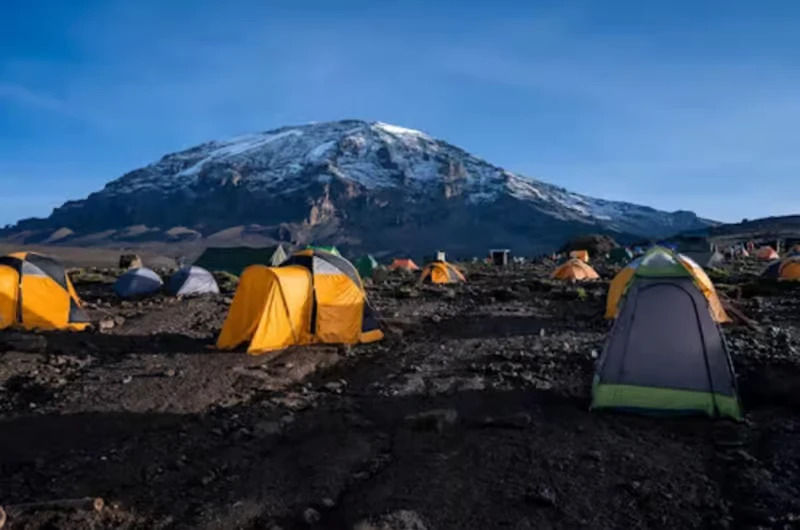
You leave the forest shortly after breakfast as the trail steepens up a ridge through heather and moorland. The trees fall away fast, and Kibo’s glaciers appear ahead — the first full view of the summit you are walking toward. Giant groundsels and lobelias line the path, and the air cools noticeably with every hundred metres gained.
This is a short but consistently uphill day of about 4–5 hours, ending at Shira Camp (3,840 m) on the edge of the Shira Plateau. Because you sleep some 800 metres higher than the night before, guides watch the group closely this evening: drink steadily, eat even if appetite fades, and say so if a headache builds.
Afternoon at Shira is for rest and short acclimatization walks around camp with big views west across the plateau. Dinner in the mess tent, an early night, and tomorrow the famous Lava Tower day.
- Accommodation: Shira Camp (3,840 m)
- Meals: Breakfast, lunch, dinner
- Trekking time: Approximately 4–5 hours
- Trekking distance: 7 km (4.3 miles); elevation gain 790 m (2,592 ft)
- Altitude: 3,840 m (12,600 ft) above sea level

The most important acclimatization day of the climb. You ascend steadily through alpine desert to Lava Tower (4,630 m), a 300-foot volcanic plug that is the highest point reached before summit night. Lunch is served at or near the Tower — appetites are often small up here, which is normal — and the guides use the stop to check how everyone handles the thin air.
Then comes the reward for the effort: a long descent of nearly 700 metres into the Barranco Valley, following the classic ‘climb high, sleep low’ principle. The vegetation returns as you drop — giant groundsels crowd the valley — and most climbers feel strength returning with the thicker air. Barranco Camp (3,960 m) sits in a spectacular amphitheatre beneath the Barranco Wall and the glaciers.
Expect 6–8 hours on your feet including the lunch stop. Evening at Barranco is relaxed: dinner, the Wall looming above tomorrow’s route, and usually the best sleep since Machame Camp.
- Accommodation: Barranco Camp (3,960 m)
- Meals: Breakfast, lunch, dinner
- Trekking time: Approximately 6–8 hours
- Trekking distance: Approximately 10 km (6.2 miles)
- Altitude: Up to 4,630 m at Lava Tower; sleep at 3,960 m
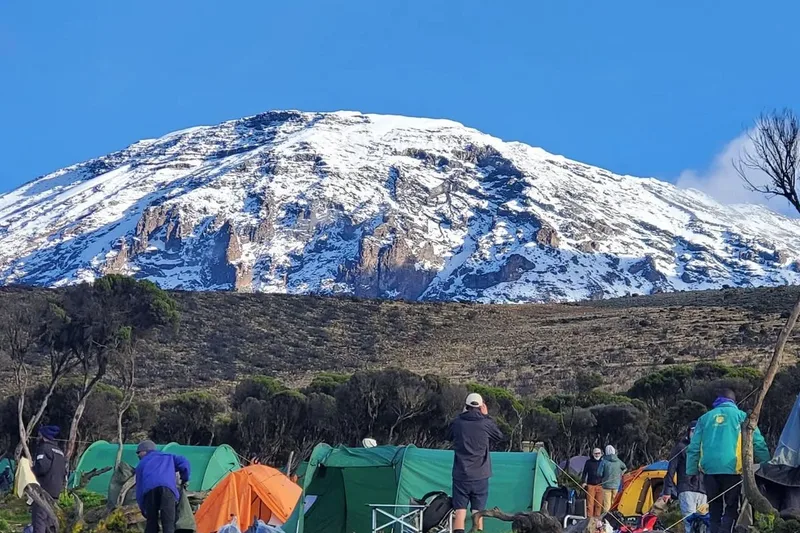
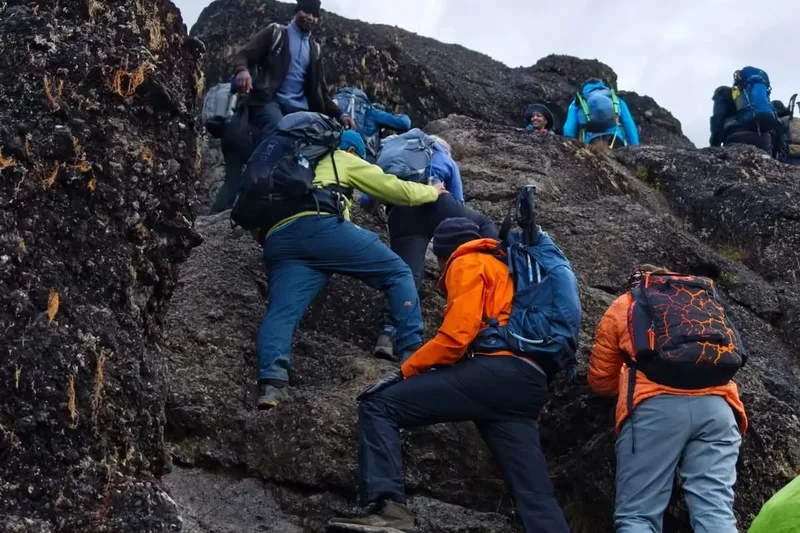
Morning starts with the famous Barranco Wall — a steep rocky scramble that looks far harder than it is. Your guides pick the line, hands are needed in a few short sections including the ‘Kissing Rock’, and porters flow past with impossible balance. Within an hour or two the Wall is behind you and the trail opens into rolling valleys with huge views back to Meru.
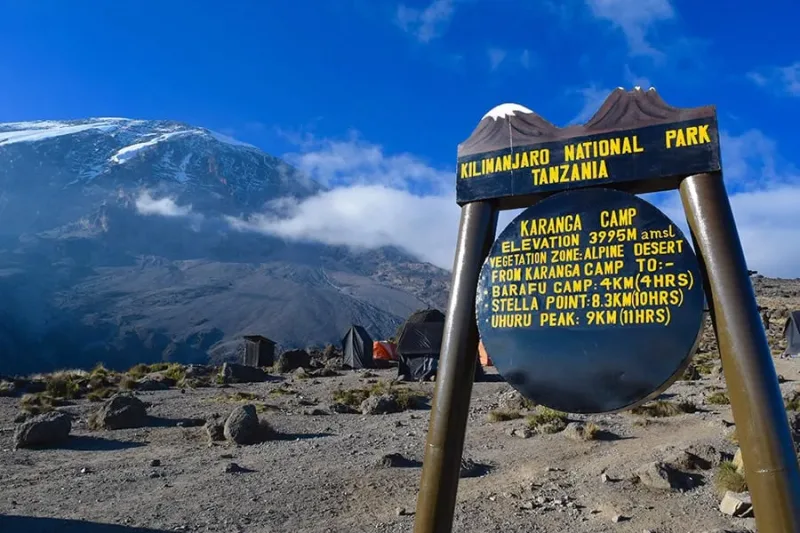
The afternoon is deliberately short: across the Karanga Valley and up to Karanga Camp (3,995 m) in a total of 4–5 hours. This is the extra day that makes the 7-day itinerary — an afternoon of rest at nearly 4,000 metres, letting your body consolidate three nights above 3,800 metres before Barafu.
Lunch at camp, optional short walks, an early dinner and bed. Guides check oxygen and pulse this evening on most Kizza climbs; numbers guide decisions, and honesty about symptoms matters more than pride.
- Accommodation: Karanga Camp (3,995 m)
- Meals: Breakfast, lunch, dinner
- Trekking time: Approximately 4–5 hours
- Trekking distance: Approximately 5 km (3.1 miles)
- Altitude: Approximately 3,995 m (13,106 ft) above sea level
A short, steep morning up the rocky ridge joining the southern circuit beneath the Heim Glacier. Barafu — ‘ice’ in Swahili — sits at 4,673 m on an exposed, windswept saddle with the summit route rising directly above camp. The landscape is bare rock and ice; water and every supply arrives on porters’ backs.
After approximately 3–4 hours of trekking you arrive at Barafu Camp (4,673 m / 15,331 ft), your base camp for the final ascent. You will have lunch, rest, and prepare your summit clothing and equipment. The rest of the day is preparation: kit check for the midnight ascent, an early dinner around 5–6 pm, and a few hours of restless sleep in full layers. Your guide confirms the wake-up call — usually around 11 pm — and the summit plan: hot drinks, headlamps, and a midnight departure.
Weather at Barafu changes fast and wind chill is serious even in dry season; gaiters, balaclava, summit gloves and spare batteries go in the summit pack tonight, not tomorrow.
- Accommodation: Barafu Camp (4,673 m)
- Meals: Breakfast, lunch, dinner
- Trekking time: 3–4 hours
- Trekking distance: Approximately 4 km (2.5 miles); elevation gain approximately 678 m (2,224 ft)
- Altitude: Approximately 4,673 m (15,331 ft) above sea level

Wake-up around 11 pm, hot tea and biscuits, and step into the dark by midnight. The trail switchbacks up scree and rock for 5–7 hours to Stella Point (5,756 m) on the crater rim — then, as dawn breaks, the final gentle rise to Uhuru Peak (5,895 m). Sunrise over Mawenzi from the roof of Africa repays everything; photos at the sign, then descend promptly, because the altitude remains dangerous even in triumph.
Back at Barafu by late morning for a short rest and brunch, you shoulder the pack again and descend scree and moorland all afternoon to Mweka Camp (3,100 m) in the upper forest — a knee-testing 3–4 hours. Total for the day: approximately 10–15 hours and 14–17 km, the hardest and greatest day of the trek.
Dinner tastes better than any meal of the trip, and sleep at Mweka — nearly 2,800 metres below the summit — is deep. Summit certificates (gold for Uhuru, green for Stella/Gilman’s) are issued at the gate tomorrow.
- Accommodation: Mweka Camp (3,100 m)
- Meals: Breakfast, lunch, dinner
- Trekking time: Approximately 10–15 hours
- Trekking distance: Approximately 14–17 km (8.7–10.6 miles); distance to summit 4.86 km (3 miles); elevation gain to summit 1,222 m (4,009 ft)
- Altitude: Uhuru Peak 5,895 m; sleep at 3,100 m
After breakfast at Mweka Camp, a 3–5 hour final descent through lush montane rainforest to Mweka Gate (1,640 m / 5,380 ft), where you sign out, receive your summit certificate, and — tradition demands — tip the crew as a group. The mountain falls silent behind you; the forest that began the trek closes it.
Our vehicle waits at the gate for the drive back to Moshi (about an hour, traffic and road works permitting), arriving for lunch and hotel check-in. Hot showers, real beds, and an afternoon to rest, explore Moshi, or celebrate.
Flights, safaris and Zanzibar extensions start the next day at the earliest — never book onward travel for summit night or the evening of descent. Weather, gate queues and tired legs all argue for one buffer night in Moshi.
- Accommodation: Moshi hotel
- Meals: Breakfast and lunch
- Trekking time: 3–5 hours
- Trekking distance: Approximately 10 km (6.2 miles)
- Altitude: Descend to 1,640 m (5,380 ft) at Mweka Gate; elevation loss approximately 1,460 m (4,790 ft)
Machame Route Campsites
The Machame Route is a camping-only route — no huts. Here are the campsites you’ll sleep at.
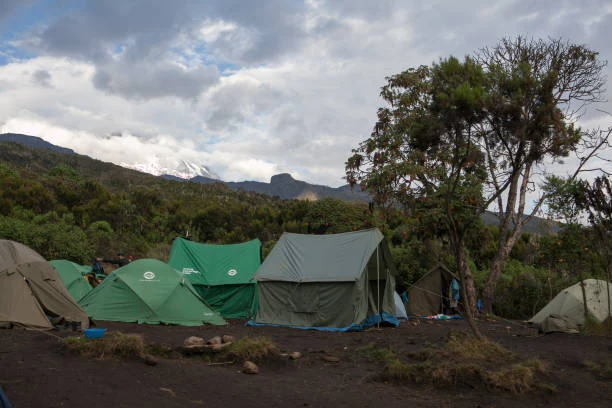
Machame Camp (3,000 m)
Elevation: 3,000 m
Terrain: Forest edge clearing
Facilities: Tent platforms, basic toilets
Water: Stream water (treated)
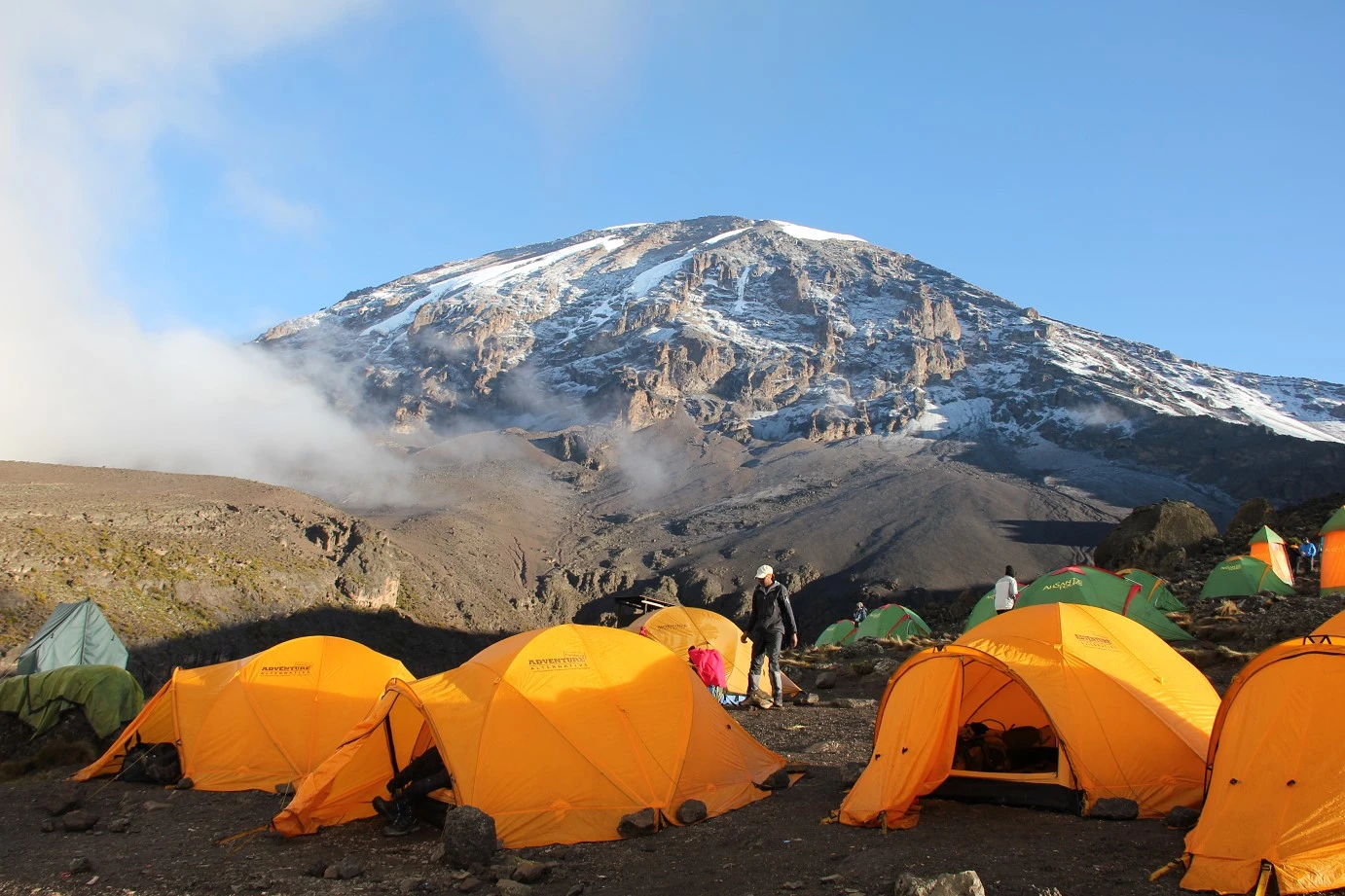
Your first night on the mountain, just above the rainforest at approximately 3,000 m. Tents glow under the canopy while the crew serves dinner in the mess tent.
Shira Camp (3,840 m)
Elevation: 3,840 m
Terrain: Open moorland plateau
Facilities: Tent platforms, basic toilets
Water: Stream water (treated)
A big-sky camp on the plateau edge with Kibo dead ahead. Cold, exposed and unforgettable — sleep warm tonight, you gained 1,000 metres today.
Barranco Camp (3,960 m)
Elevation: 3,960 m
Terrain: Sheltered valley
Facilities: Tent platforms, basic toilets
Water: Stream water (treated)
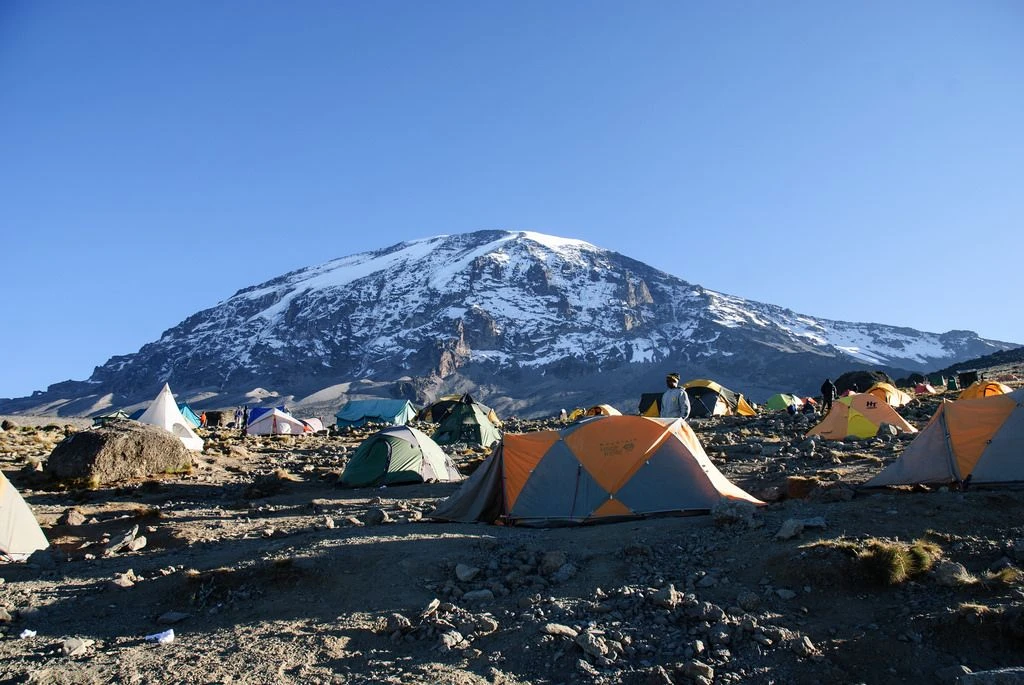
In a lush valley under the Barranco Wall, ringed by giant groundsels with the Heim Glacier above. Most climbers’ favourite camp on Kilimanjaro.
Karanga Camp (3,995 m)
Elevation: 3,995 m
Terrain: Rocky ridge
Facilities: Tent platforms, basic toilets
Water: Last reliable water point
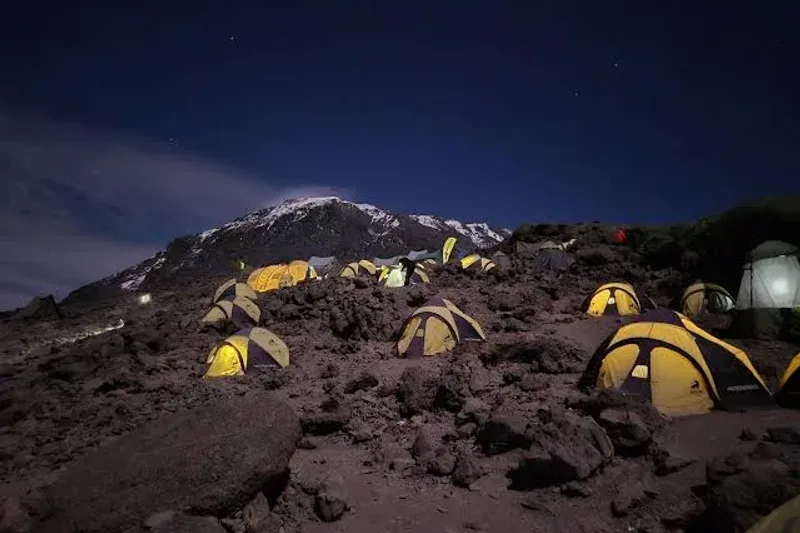
The extra night that makes the 7-day itinerary — small, stark and perfectly placed for acclimatization. Water carried from here supplies Barafu.
Barafu Camp (4,673 m)
Elevation: 4,673 m
Terrain: Rocky, exposed saddle
Facilities: Tent platforms, basic toilets
Water: No water — carried from Karanga
Summit base camp: barren, windy and cold. Rest is the only job here before the midnight ascent to Uhuru Peak.
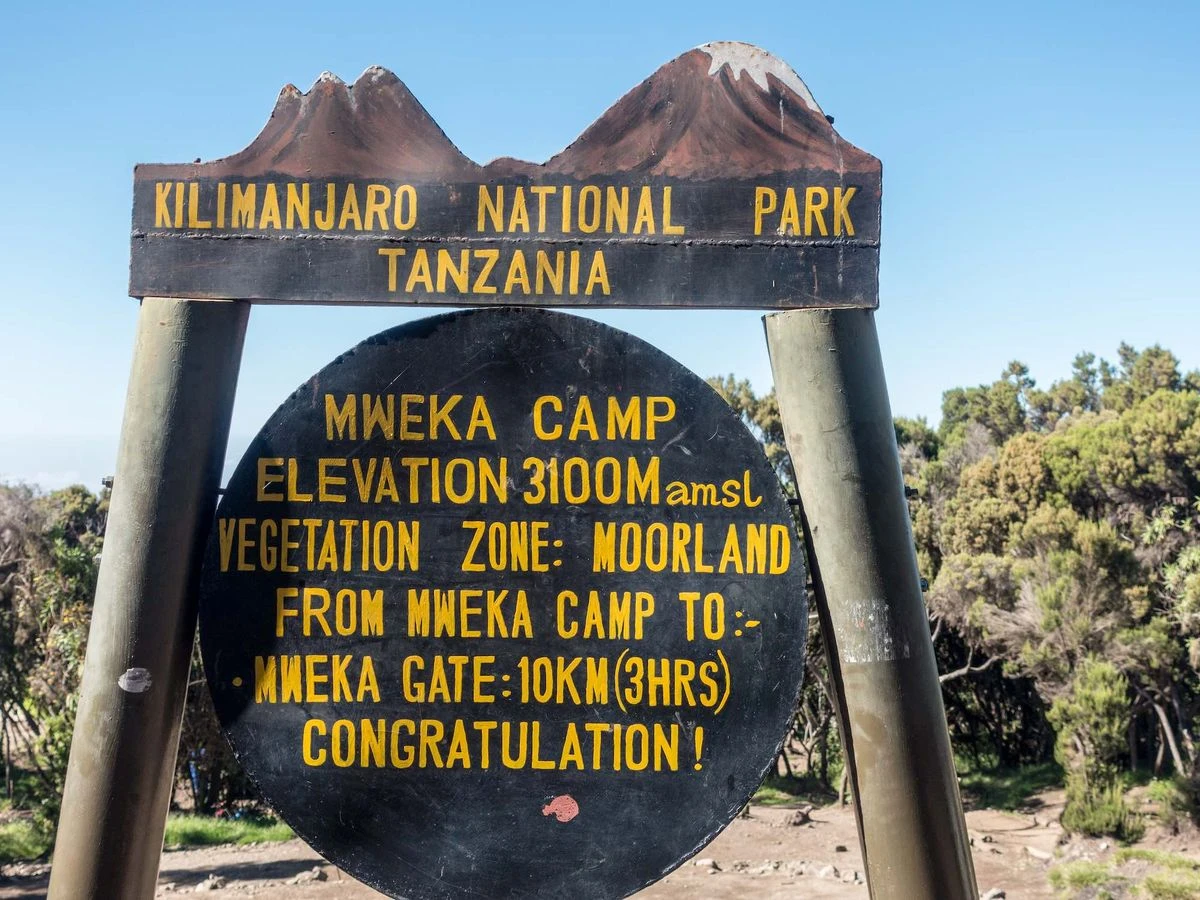
Mweka Camp (3,100 m)
Elevation: 3,100 m
Terrain: Upper forest clearing
Facilities: Tent platforms, basic toilets
Water: Stream water (treated)
The celebration camp after summit day — back in the forest, breathing thick air, sleeping the deepest sleep of the trek.
Understanding Altitude on the Machame Route
Altitude sickness is the biggest challenge. Knowledge is your best defence.
Altitude sickness (AMS) affects nearly everyone above 3,000 m to some degree. The Machame 7-day itinerary handles it with the classic “climb high, sleep low” design: up to Lava Tower (4,630 m) on day 3, then down to sleep at Barranco (3,960 m), plus the extra consolidation night at Karanga (3,995 m). The 6-day itinerary skips that Karanga night — which is precisely why it suits pre-acclimatized trekkers better than sea-level beginners. Symptoms include headache, nausea, dizziness and fatigue; no company can promise how your body will respond.
Pole pole (slowly slowly in Swahili) is the golden rule. Your guides are trained to recognize early signs of altitude sickness and will make critical decisions about whether it is safe for you to continue. Prevention is everything — climb slowly, stay hydrated, eat well, and listen to your guide. Trust their judgment: they have your safety as their top priority.
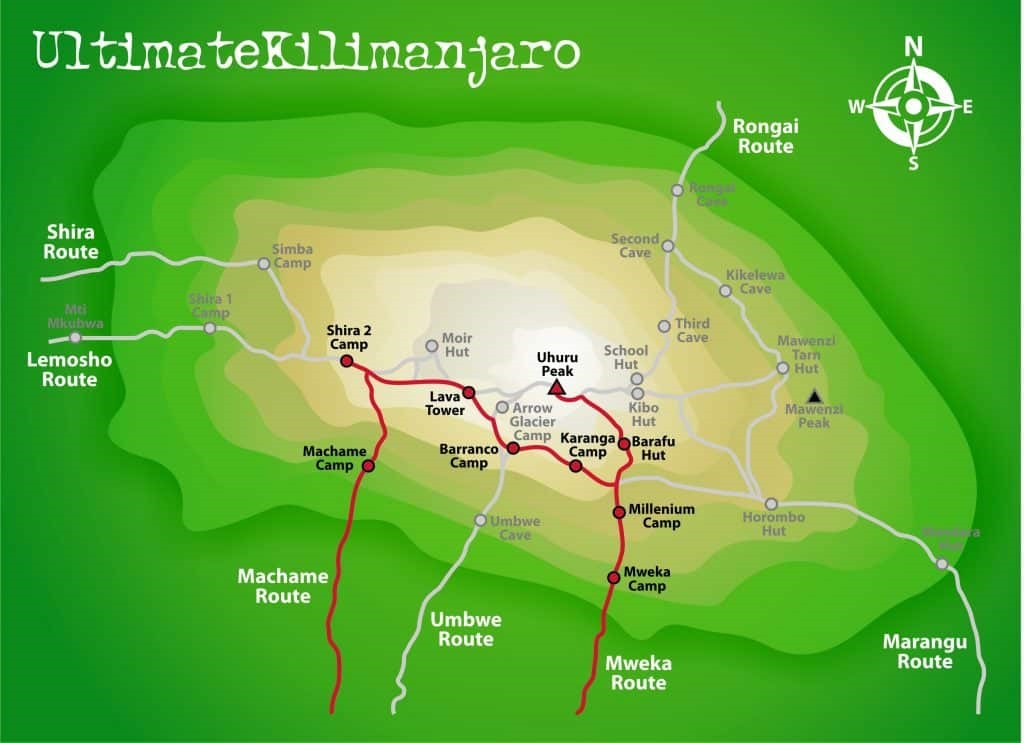
Machame Route Map & Trail Overview
Visualise the entire Machame Route from Machame Gate to the summit and down via Mweka.
How Hard Is the Machame Route?
The Machame Route is rated as challenging but achievable for anyone with good fitness and determination — which is exactly why it earned the Whiskey Route nickname. Expect steep sections including the Barranco Wall (a non-technical scramble with hands-on moments), long days of up to 10 km, camping at high altitude, and a summit night of 10–14 hours round-trip in freezing temperatures at extreme altitude.
Who can climb? Active individuals with good cardiovascular fitness and some hiking experience are best suited for Machame. You should be comfortable walking 4–9 hours a day over varied terrain, including steep rocky sections. Previous high-altitude experience is helpful but not essential — what matters most is your body’s response to altitude, which is impossible to predict before you go. On the 6-day itinerary, arrive pre-acclimatized (Meru, Kenya or Rwenzori first) or choose 7 days.
Training recommendation: Start preparing 2–3 months before your climb. Focus on cardiovascular fitness (hiking, running, cycling, stairs) and leg strength (squats, lunges). Practice hiking with a loaded daypack on varied terrain, and rehearse steep scrambling on rocky hills for the Barranco Wall. Do not underestimate mental preparation — summit night will push you beyond where you thought your limits were.
Machame Route Summit Success Factors
The Machame Route gives climbers among the best summit odds on Kilimanjaro — around 85–90% estimated on the 7-day itinerary, 70–75% on the 6-day, provided you take 7 days. The Lava Tower ‘climb high, sleep low’ day plus the extra consolidation night at Karanga build one of the strongest acclimatization profiles on the mountain. The 6-day itinerary skips that Karanga night, and summit odds fall with it — which is why our guides recommend 7 days to every sea-level beginner.
At Kizza Adventures, we run full itineraries with proper acclimatization pacing, experienced guides trained in altitude sickness recognition, careful health monitoring at every stage, and a policy of never rushing climbers. We publish honest guidance — not invented house records — because no operator can guarantee any individual summit.
Expert tip: The key to success on Machame is choosing the 7-day option and walking pole pole from Machame Gate onward.
| Itinerary | Estimated Success | Acclimatization Profile | Who It Suits |
|---|---|---|---|
| 6-Day Machame | ~70–75%* | Compressed — no Karanga night | Pre-acclimatized, experienced trekkers only |
| 7-Day Machame | ~85–90%* | Strong — Karanga night included | The standard; our pick for fit first-timers |
*Indicative industry estimates, not guaranteed results — published figures vary between operators. Your fitness, pacing, hydration, weather and individual physiology all decide summits. The extra day makes a significant difference in your body’s ability to adapt to altitude. Trust the itinerary, follow your guide’s advice, and maintain a consistent intake of water and food throughout each day.
When Should You Climb the Machame Route?
The best time to climb the Machame Route is during the dry seasons: June to October and January to March. These months offer the kindest conditions with clearer skies, drier trails on the Barranco Wall, and the most reliable summit weather.
June–October: The peak climbing season. Expect clear skies, excellent visibility for the Shira and Barranco viewpoints, and colder summit nights. Trails and camps are at their busiest but conditions are most reliable. Daytime temperatures at lower elevations are pleasant (15–25°C) while summit night temperatures can drop to −15°C to −25°C.
January–March: The second dry season, with slightly warmer temperatures and thinner crowds than June–October. January and February are particularly popular on Machame. Summit skies are often superb.
April–May & November: The rainy seasons. Trails turn slippery and muddy — the Barranco Wall and the Mweka descent demand extra care — clouds hide the views, and bail-outs rise. With quality rain gear and flexible expectations it remains climbable, and crowds are thinnest; tell us your dates and we will advise honestly.
Ultimate Kilimanjaro Packing List
Everything you need to reach Uhuru Peak — download our free comprehensive packing guide.
Proper packing can mean the difference between a successful summit and a struggle. Kilimanjaro takes you through five climate zones — from warm rainforest at the base to freezing Arctic conditions at 5,895m. Our expert guides have created a complete packing checklist covering every layer, piece of gear, and essential item you'll need.
At Kizza Adventures, we review every climber's gear before departure to maximise safety and summit success.
View Full Packing ListPrintable page — open, then print or save as PDF.
How Much Does the Machame Route Cost?
The cost of climbing Kilimanjaro via the Machame Route with fixed per-person rates: 6-Day Private $2,000 · 7-Day Private $2,150 · 6-Day Luxury $2,790 · 7-Day Luxury $3,000 · 6-Day Group Join $1,780 · 7-Day Group Join $1,890. Every rate is per person. At Kizza Adventures, we offer transparent pricing with no hidden fees.
| Package | Price (USD) | Details |
|---|---|---|
| Private Machame Route — your own guide and crew | ||
| 6-Day Private Machame Route | $2,000 | Per person |
| 7-Day Private Machame Route | $2,150 | Per person |
| Luxury Machame Route — premium service and comfort | ||
| 6-Day Luxury Machame Route | $2,790 | Per person |
| 7-Day Luxury Machame Route | $3,000 | Per person |
| Group Join Machame Route — join fellow climbers | ||
| 6-Day Group Join Machame Route | $1,780 | Per person |
| 7-Day Group Join Machame Route | $1,890 | Per person |
| Park entrance fees | $200-300 | Included in package |
| Guide fees | $200-350 | Professional, certified guide |
| Porter fees | $150-250 | Full crew; you carry only a daypack |
| Camping fees | $200-300 | Per night at each camp |
| Meals on mountain | $150-250 | 3 meals + snacks daily |
| Transport (Moshi ⇆ Gate) | $50-80 | Round trip transfer |
| Equipment rental | $100-250 | Sleeping bag, poles, etc. if needed |
| Tips (guides + porters) | $200-400 | Recommended, not mandatory |
| Travel insurance | $50-100 | Must cover high-altitude trekking |
Why prices vary: Group joins share crew and camp costs across climbers; parties of 4+ earn private-group discounts. The 7-day itinerary costs more than the 6-day (an extra day of park fees, crew wages and food). Luxury packages add premium service and comfort. Always check what’s included before booking — we pride ourselves on honest, transparent pricing — inclusions and exclusions spelled out before you book.
Machame vs Other Kilimanjaro Routes
How does the Machame Route compare to Kilimanjaro’s other climbing routes?
| Feature | Machame | Marangu | Lemosho | Rongai | Northern Circuit | Umbwe |
|---|---|---|---|---|---|---|
| ★ Our Pick | Most popular | Easiest | Scenic | Remote | Longest | Toughest |
| Difficulty | Challenging | Moderate | Challenging | Moderate | Moderate-Challenging | Very Challenging |
| Days | 6-7 | 5-6 | 7-8 | 6-7 | 8-9 | 5-7 |
| Scenery | Excellent | Good | Excellent | Good | Excellent | Excellent |
| Crowds | High | High | Moderate | Low | Low | Low |
| Accommodation | Camping | Huts | Camping | Camping | Camping | Camping |
| Our Recommendation | Best value | Beginners | Best overall | Rainy season | Max acclimatization | Experienced only |
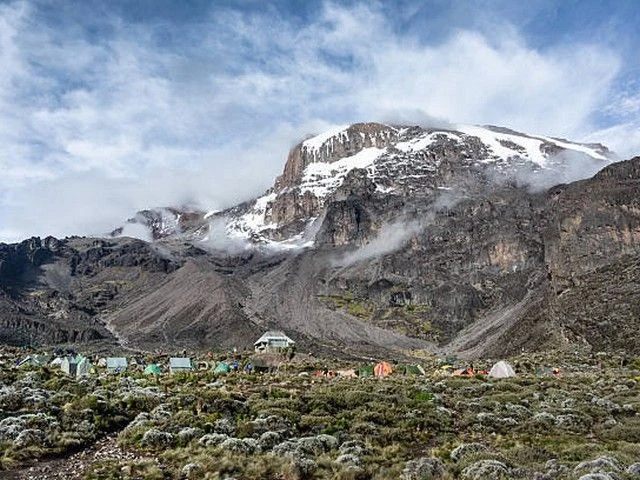
Machame Route Photo Gallery

Machame Route Price Calculator
Pick your package and climbers — every rate below is per person, exactly as quoted by our team.
Estimate only — your exact quote is confirmed in writing at booking. Get exact quote on WhatsApp →
Climbing Cost Includes
Everything below is covered in your Machame package — confirmed with your booking, never assumed on this page.
All Park Fees
Kilimanjaro National Park entry, camping, conservation and rescue fees are fully covered in your package — including government taxes and applicable fees. These charges make up a large share of any Kilimanjaro price and are the reason genuine climbs never cost a few hundred dollars. No gate surprises, ever.
Camping Fees & Arrangements
Designated campsites at Machame, Shira, Barranco, Karanga, Barafu and Mweka with quality tents pitched, arranged and struck by the mountain crew every day — plus a dining mess tent, sleeping mats and hot washing water at every camp.
Guides, Cook & Porters
Licensed English-speaking guides with Wilderness First Responder training, a mountain cook and a full crew of porters, waiters and camp managers. Porters carry tents, food and your duffel (weight limits briefed before departure) so you carry only a light daypack — and the crew's twice-daily health checks watch over you and your porters alike.
All Meals + Treated Water
Breakfast, lunch and dinner freshly prepared by our mountain cook — porridge and eggs at dawn, hot lunches on the trail, soups, stews and fresh fruit at night — plus treated safe drinking water all day, every day. Vegetarian, vegan, gluten-free and lactose-free plans cost nothing extra when you tell us at booking; expect 4+ litres a day at altitude.
All Transfers
Hotel to Machame Gate and back from Mweka Gate, with Kilimanjaro airport transfers on packages that include them — met on arrival by an English-speaking driver, confirmed with your booking.
Rescue Fee & Mountain Safety
Park rescue fees covered and genuine mountain safety on every climb: twice-daily medical check-ups with pulse oximeters, conservative descent decisions at the first warning signs, and evacuation support to Moshi hospital care if ever needed. Safety calls are the guide's alone — never a vote.
First-Aid Kit & Emergency Oxygen
A complete group medical kit on every climb — wound care, blister treatment, pain relief, altitude-sickness medication, splints and bandages — plus bottled emergency oxygen carried for genuine emergencies and administered at the first warning signs, not as a last resort.
Portable Toilet
A portable toilet tent, set up at each camp away from sleeping tents and serviced daily by the crew — confirmed with your booking.
Sleeping Bag
A warm mountain sleeping bag is included in your package — confirmed with your booking. Bring your own if you prefer; proper sleeping equipment matters because temperatures drop considerably at the higher camps.
Summit Certificate
Your official Kilimanjaro summit certificate — gold for Uhuru Peak, green for Stella Point and Gilman's Point — presented at Mweka Gate and a free lifetime souvenir of the roof of Africa.
Hotel Nights
Comfortable Moshi hotel stays with breakfast before and after the trek on packages that include them — hot shower, real bed, gear store and briefing room waiting at the bottom. Extra nights easily added.
Briefing & Support
Full pre-climb briefing the evening before — gear inspection item by item, route and weather review, health forms and emergency contacts — plus a team on call from booking to certificate, and free gear advice any time before you fly.
Climbing Cost Excludes
Honest extras to budget for — nothing hidden, nothing surprising at the gate.
International Flights
Flights to and from Kilimanjaro International Airport are not included.
Tanzania Visa Fees
Visa costs are paid by the traveller; e-visa available online in advance.
Travel & Medical Insurance
Mandatory high-altitude cover is not included — it must cover rescue up to 6,000 m.
Personal Equipment
Personal trekking equipment you bring yourself — boots, layers, poles and accessories — is not included; quality rental is available in Moshi. Sleeping bag is included — see above.
Crew Tips
Tips for guides, cook and porters are not included but warmly recommended.
Laundry Service
Laundry on the mountain and at hotels stays yours.
Alcoholic & Soft Drinks
Alcoholic drinks and hotel soft drinks are excluded — altitude and alcohol do not mix.
Join a Machame Group Climb
Share the trail, the costs and the summit sunrise — group departures run in every season.
How group joining works
Tell us your dates and we match you with fellow climbers on the same Machame itinerary — same route, same professional crew, shared costs. Solo travellers welcome; you will never be forced into a date that does not suit you.
Group joins from $1,780 per person (6-day) and $1,890 (7-day). Group size, departure grouping and your guide team are confirmed in writing at booking — never assumed on this page.
Plan With Maghret in Moshi
Real answers, fast, from the team that runs these climbs every week.
Want to plan a memorable Tanzanian adventure? Message Maghret directly — Machame dates, group sizes, prices and preparation, answered fast by someone who plans these climbs every day.
Chat on WhatsAppWhat Machame Climbers Say About Kizza Adventures
Unfiltered words from real Machame summits — read every review on our public profiles below.
TripAdvisor
Photos, summit stories and honest ratings from climbers we guided — the full public record.
Read Reviews on TripAdvisor →Google Reviews
Star ratings and trip reports from our Machame, safari and Zanzibar guests — updated daily.
Read Reviews on Google →Machame Route — Frequently Asked Questions
Everything you need to know before you go.
The Machame Route is the most popular trekking route on Mount Kilimanjaro, approaching the mountain from the southern side. It is well known for its beautiful scenery, diverse vegetation zones, and camping experience. During the climb, trekkers pass through tropical rainforest, heathland, moorland, alpine desert, and the high-altitude summit zone before attempting to reach Uhuru Peak at 5,895 metres.
At Kizza Adventures, we recommend the Machame Route to climbers who want a scenic mountain experience combined with opportunities for acclimatization. The route involves several long trekking days and some physically demanding sections, so proper preparation is important. Although it does not require technical mountaineering skills, climbers should be ready for changing weather, steep trails, and the challenges associated with high altitude.
The Machame Route is commonly completed in six or seven days on the mountain. The six-day itinerary is shorter and requires climbers to manage the trekking schedule with less time for acclimatization, while the seven-day itinerary includes an additional overnight stop that allows more time to adjust to increasing altitude.
At Kizza Adventures, we generally recommend the seven-day Machame Route for most climbers because a more gradual itinerary provides a better opportunity for acclimatization. However, additional days cannot guarantee summit success, as every person responds differently to altitude. Your fitness, health, walking pace, and the decisions made by your mountain guide all contribute to the overall experience.
The Machame Route leads to Uhuru Peak, the highest point on Mount Kilimanjaro and the highest mountain summit in Africa, standing at 5,895 metres (19,341 feet) above sea level. Reaching this altitude is a significant physical achievement because the amount of available oxygen decreases as you climb higher.
As experienced Kilimanjaro trekking professionals, we advise climbers to understand that reaching the summit is not only about physical strength. The ability to walk slowly, maintain a steady pace, stay hydrated, eat adequately, and communicate symptoms to the guide team is equally important. Our approach is to prioritize safe progress and responsible decision-making throughout the ascent.
The Machame Route is popularly nicknamed the Whiskey Route because it has traditionally been regarded as a more demanding alternative to the Marangu Route, which is often called the Coca-Cola Route. These nicknames are informal trekking expressions used to distinguish the routes according to their traditional reputations and styles of climbing.
The name does not mean that climbers need to drink alcohol or that the route requires advanced technical climbing skills. The Machame Route is a non-technical trekking route, but it includes longer walking days, camping, steep sections, and high-altitude challenges. At Kizza Adventures, we encourage climbers to prepare physically and mentally rather than relying on the route's nickname to judge its difficulty.
The Machame Route is generally considered moderately difficult to strenuous, depending on the itinerary, a climber's fitness, and their response to altitude. Some sections involve steep ascents and descents, rocky terrain, and long walking days. Summit night is particularly demanding because climbers begin walking during the night and continue in cold conditions at very high altitude.
In our approach to Kilimanjaro trekking, preparation and pacing are essential for managing these challenges. Regular hiking, uphill walking, cardiovascular exercise, and training with a backpack can help prepare your body for the demands of the mountain. However, even physically fit climbers can experience altitude sickness, so fitness should never be treated as a guarantee of reaching Uhuru Peak.
Yes, beginners can climb the Machame Route if they are reasonably fit, properly prepared, and able to cope with several consecutive days of trekking. Previous mountaineering experience is not a formal requirement because the route does not normally involve technical climbing with ropes. Nevertheless, beginners should understand that climbing Kilimanjaro is a serious high-altitude undertaking rather than an ordinary hiking holiday.
At Kizza Adventures, we encourage first-time climbers to begin training well before arrival in Tanzania. Walking regularly, practising on hills, improving cardiovascular endurance, and wearing suitable hiking boots can make the experience more manageable. We also recommend choosing an itinerary that provides sufficient acclimatization time and being honest with your guide about tiredness, discomfort, or any symptoms experienced on the mountain.
No, technical mountaineering experience is not normally required for the standard Machame Route. Most of the journey involves hiking on established mountain trails, although the terrain changes significantly as you gain altitude. Climbers need good balance, suitable footwear, and the ability to walk for extended periods over uneven ground.
One of the most talked-about sections is the Barranco Wall, where trekkers negotiate steep rocky terrain using their hands and feet in places. It is generally considered a scrambling section rather than a technical rock-climbing route, but it still requires concentration and careful movement. Our advice is to follow the guide's instructions, avoid rushing, and take extra care when the rocks are wet or conditions are difficult.
The main difference is the amount of time available for the climb and acclimatization. The six-day itinerary combines the route into a shorter schedule, whereas the seven-day itinerary normally includes an additional overnight stop at Karanga Camp before continuing to Barafu Camp. This allows a more gradual progression through the mountain's different altitude zones.
At Kizza Adventures, we generally favour the seven-day itinerary for climbers who have enough time because acclimatization is an important part of high-altitude trekking. A longer itinerary can improve the opportunity to adapt, although it cannot eliminate the risk of altitude sickness. The final choice should take into account your schedule, previous high-altitude experience, budget, and willingness to spend additional time on the mountain.
The summit success rate on the Machame Route is generally estimated at around 70–75% for the 6-day itinerary and 85–90% for the 7-day itinerary. These are indicative industry estimates, not guaranteed results, and published figures vary between trekking operators. The seven-day itinerary generally offers a better chance of reaching Uhuru Peak because it allows more time for acclimatization before summit night.
At Kizza Adventures, we recommend the 7-day Machame Route for most climbers because gradual acclimatization can improve the chances of reaching the summit safely. However, your personal success depends on several factors, including your body's response to altitude, physical preparation, weather conditions, and the guidance you receive throughout the climb. We believe in giving our clients realistic expectations: our goal is to help you reach Uhuru Peak when conditions allow while always prioritizing your health and safe return.
Common symptoms include headache, nausea, dizziness, unusual fatigue, and loss of appetite. Symptoms may develop even in climbers who are physically fit, and they should never be dismissed simply because someone has trained extensively before the climb.
Our advice is to report symptoms to your guide as soon as they appear rather than hiding them to continue towards the summit. Severe breathlessness at rest, confusion, difficulty walking straight, or worsening symptoms require urgent medical assessment and may require immediate descent. Guides should follow established mountain safety procedures, and emergency oxygen or other equipment should be used according to appropriate training and medical protocols.
The Machame Route begins at Machame Gate, located on the southern side of Mount Kilimanjaro. After registration and the necessary entry procedures, climbers begin trekking through the rainforest before continuing through the higher mountain camps towards the summit. The first day's walking distance and duration depend on the itinerary, trail conditions, and the group's pace.
After the summit attempt, climbers descend towards Mweka Camp and continue to Mweka Gate, where the trek officially ends. Using a different descent trail gives climbers another perspective of the mountain and helps complete the usual Machame circuit. Kizza Adventures can arrange the trekking logistics according to the booked package, so clients should confirm airport transfers, hotel accommodation, and other inclusions before travelling.
On the standard seven-day Machame itinerary, climbers generally spend nights at Machame Camp, Shira Cave Camp, Barranco Camp, Karanga Camp, Barafu Camp, and Mweka Camp during the descent. These camps are positioned at different elevations and serve as overnight stops as climbers progress through the mountain's ecological zones.
Lava Tower is usually visited during the day as part of an acclimatization schedule rather than used as an overnight camp on the standard itinerary. Exact arrangements can vary according to the itinerary, park regulations, and operational conditions. Before booking with Kizza Adventures, ask for the complete day-by-day schedule so that you understand where you will sleep, the expected walking hours, and the altitude reached each day.
The Barranco Wall is a prominent rocky section of the Machame Route that climbers normally cross after spending the night at Barranco Camp. It involves steep scrambling in places, with some sections requiring the use of hands for balance and support. Although it can look intimidating from the camp, many trekkers with reasonable mobility complete it by moving carefully and following their guides' instructions.
Climbers should avoid rushing, maintain secure footing, and wait for instructions before moving through difficult sections. The guide should assess conditions and the abilities of the group throughout the crossing. Anyone with significant mobility limitations or a strong fear of exposed terrain should discuss their concerns with the operator before booking.
Summit night usually begins around midnight from Barafu Camp, although the exact departure time depends on the guide's plan and prevailing conditions. Climbers ascend slowly towards Stella Point on the crater rim, then continue towards Uhuru Peak if their condition, weather, and safety allow. This part of the climb is demanding because it combines darkness, cold temperatures, steep terrain, and very high altitude.
After reaching the summit, climbers take photographs and spend only the necessary time at the top before beginning the descent. The group usually returns towards Barafu Camp before continuing to a lower camp, commonly Mweka Camp, depending on the itinerary and conditions. Summit night requires warm clothing, a headlamp, adequate hydration and nutrition, and close communication with the guide team.
The Machame Route offers a wide variety of landscapes as climbers move through Kilimanjaro's ecological zones. The lower slopes feature montane rainforest, where vegetation is dense and the trail can be humid or muddy. Higher up, the landscape changes into heathland and moorland, with distinctive plants, open views, and increasingly dramatic mountain scenery.
Further along the route, climbers cross the Shira Plateau and the alpine desert, with rocky landscapes and wide views of the mountain. The Barranco area is particularly striking, while the upper mountain reveals a harsher environment with limited vegetation and possible snow or ice near the summit. Weather and visibility affect what you see on each day, but the changing scenery is one of the route's major attractions.
Accommodation on the Machame Route is based on camping at designated mountain camps rather than sleeping in permanent mountain huts. Climbers generally sleep in expedition tents, with the specific tent arrangements depending on the trekking package. The camping experience allows trekkers to stay along the route while the crew manages the logistics of moving equipment and preparing the camp.
Before booking with Kizza Adventures, clients should confirm whether tents are shared or private, whether sleeping mats and sleeping bags are included, and whether a private toilet tent is available. These details can differ between packages and should not be assumed. Proper sleeping equipment is especially important because temperatures drop considerably at higher camps, and adequate rest helps climbers manage the physical demands of the following day.
On a guided Kilimanjaro trek, meals are generally prepared by the mountain crew and served according to the itinerary. Meals commonly include carbohydrate-rich foods, vegetables, fruit, and sources of protein to support energy needs during long trekking days. The exact menu varies by operator and package, so travellers should communicate allergies, dietary restrictions, and special requirements before the climb begins.
Drinking water should be treated appropriately before consumption, and climbers should carry reusable bottles or a hydration system to drink regularly throughout the day. At Kizza Adventures, the precise food and water arrangements should be confirmed in the package details, including how water is provided and whether additional drinks are included. Maintaining food and fluid intake is important, although excessive drinking is not a substitute for proper acclimatization or medical assessment.
Essential equipment includes well-fitted hiking boots, moisture-wicking base layers, warm insulating clothing, waterproof outer layers, hiking trousers, gloves, a warm hat, and a headlamp with spare batteries. A suitable backpack, trekking poles, sunglasses, sun protection, personal toiletries, and a warm sleeping bag are also important. Your clothing system should allow you to adjust to warm conditions at lower elevations and freezing temperatures near the summit.
We advise climbers to test their boots and equipment before arriving in Tanzania rather than using unfamiliar gear for the first time on the mountain. A properly fitted daypack and suitable sleeping equipment can make long days and cold nights more manageable. Kizza Adventures should provide a route-specific packing list and clarify which equipment is included in the package and which items clients must bring or rent locally.
The main drier climbing periods on Mount Kilimanjaro are generally January to early March and June to October. These periods are often preferred because conditions may be more favourable for trekking and visibility, although weather can change quickly at any elevation. Rain, wind, cold temperatures, and occasional snow can occur even during traditionally drier months.
The best dates for an individual climber depend on personal availability, tolerance for different weather conditions, and the kind of experience they want. At Kizza Adventures, we encourage travellers to plan ahead, secure their preferred dates early, and bring appropriate equipment for variable mountain weather. No month guarantees clear skies or a successful summit, so climbers should be prepared for changing conditions throughout the trek.
When choosing a trekking company, look for a clearly planned itinerary, knowledgeable mountain guides, transparent pricing, suitable equipment, and established safety procedures. A professional operator should explain what is included in the package, what costs extra, how the team manages altitude-related symptoms, and what emergency procedures are available during the climb. These details help travellers make an informed decision rather than choosing a company based only on price or promises of summit success.
At Kizza Adventures, our communication with clients should focus on helping each climber prepare properly and understand the realities of Mount Kilimanjaro. Before confirming your booking, ask for the itinerary, accommodation arrangements, meal plan, equipment provisions, park fees, and details of the guide team. We encourage a responsible approach to the mountain, where careful preparation, respect for altitude, and the safety of every climber remain central to the trekking experience.
Every Machame Route Package We Offer
Private climbs, group joins, guided expeditions and a day hike — all ten Machame ways to the roof of Africa. Fixed per-person pricing from $1,780 — see the cost breakdown.
Private Machame 6-Day
Private Machame 7-Day

Private Machame 8-Day
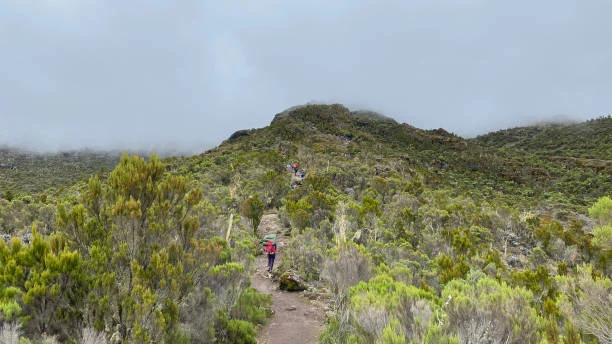
Group Join Machame 6-Day
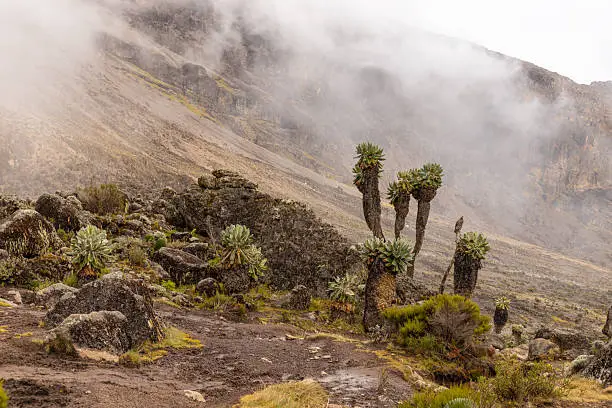
Group Join Machame 7-Day
Group Join Machame 8-Day
Machame 6-Day Climb
Machame 7-Day Climb
Machame 8-Day Climb
Machame Day Hike
Planning Your Tanzania Adventure
Everything you need to prepare for your Kilimanjaro climb and Tanzania trip.
Ready to plan your next adventure?
Tell us your ideas, and we’ll craft a personalized travel itinerary and reply within short time.
Ready to Climb the Machame Route?
Speak with a local Kilimanjaro expert today. Get a free, custom itinerary in under 24 hours.